
Recently, Inviqa’s Creative Director, Alex Blaney, and Inviqa CTO, Kaustav Bhattacharya, jumped on a webinar to explore how AI can enhance the travel journey – from the traveller’s perspective and the brand’s perspective, through the lens of ‘art of the possible.’
Kaustav opened the session, explaining that AI is already changing how customers discover, plan and make decisions about their holidays. From initial research to shortlisting preferred destinations, right down to the nitty-gritty details of a specific place to visit and stay at.
It’s beginning to unify what has traditionally been a very fragmented experience. Agentic AI can coordinate actions between different specialised agents, adapt to dynamic content, and predict a person’s needs in ways that older automation simply couldn’t. It can offer the right content and experiences at the right moments so that people can make timely and nuanced decisions.
But we’re still at wave one of the agentic AI era. The complexity of holiday planning is so deeply human that a disembodied intelligence with no sense of smell, touch or feelings can only take you so far towards your dream holiday.
It’s here that Alex takes over, and we get into the juicy details of how AI can make travel delightful at each stage of the traveller’s journey.
During the dreaming stage
At this stage of the journey, people are just starting to think about going on holiday. They’re after inspiration and imagining a new version of themselves, and don’t necessarily have a destination in mind. Yet, this is often the journey we’re pushed towards in this early stage, treating discovery as a search problem, asking where we want to go, when, and how long.
Which means they’re being pushed towards an answer before they even know what they’re actually asking.
How AI can enhance the experience
AI can make this stage more nuanced by delaying certainty. Instead of forcing decisions, it can help people sit in the ambiguity and keep dreaming longer.
Alex shared a concept he created for Aman Resorts, where guests weren’t looking for a destination but a feeling. The matrix he designed allowed them to explore resorts aligned to emotions like immersion, privacy or nature.
He also showed more abstract concepts like searching by temperature (for the cold-avoidant among us) or by budget radius – how far £x can take you.
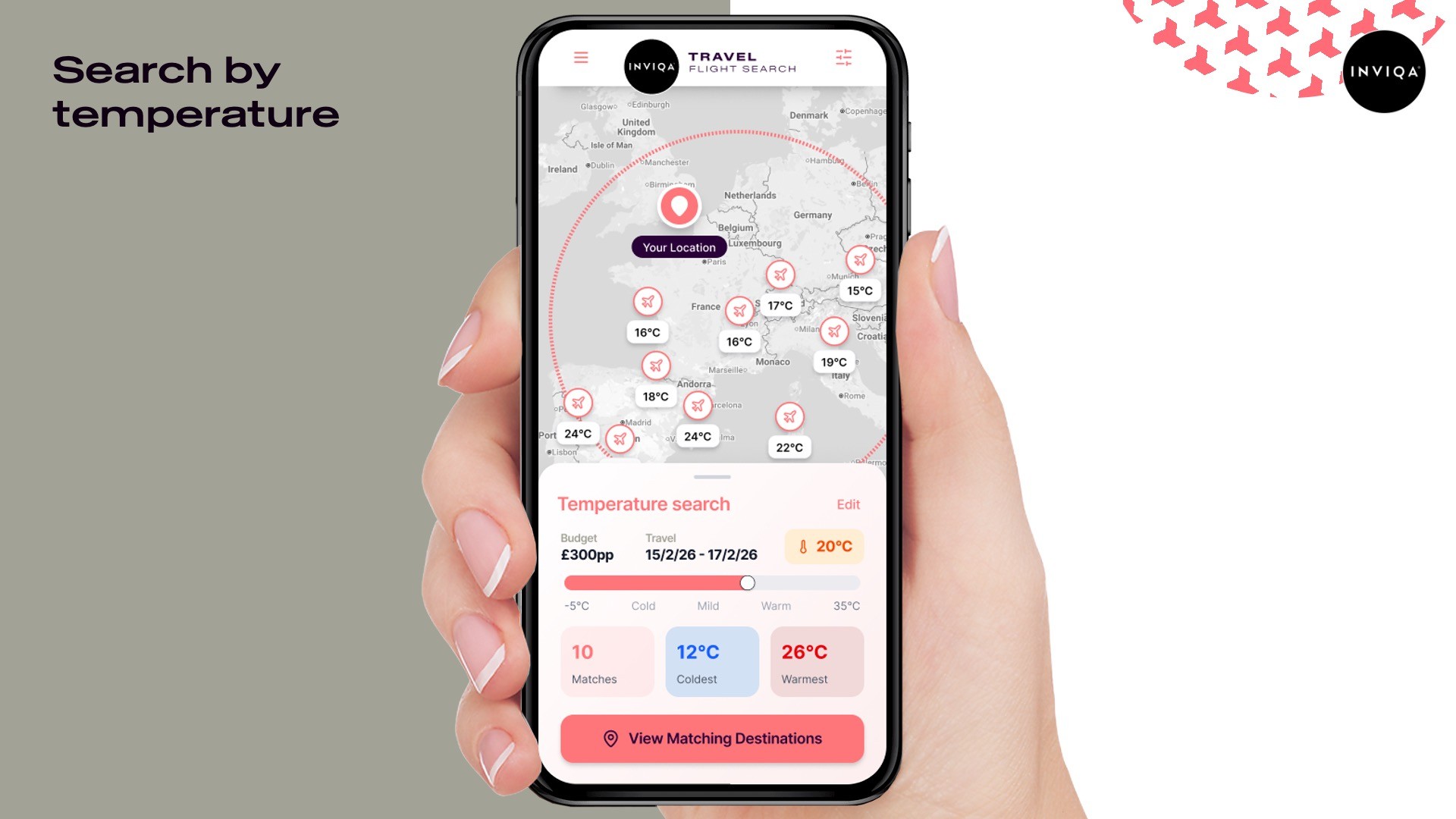
A prototype of a search-by-temperature experience
And this is where Alex made a small but important point: many of the examples he was sharing are 'art of the possible' provocations. They aren’t final designs or necessarily available in the market.
They’re designed to spark “Wouldn’t it be cool if…”, which is basically the creative department’s love language.
Key takeaway
At this stage, travellers are looking for impartiality. They want to explore options freely without being funnelled. AI lets people dream longer, and the brands that excel won’t be the loudest, but those that feel like they understood the traveller first.
At the planning stage
Now shit’s getting real. Planning is often the least ‘joyful’ part of travel. Not because it’s hard, but because people are terrified of making the wrong choice.
At this stage, people are looking for confirmation that the choice they’re about to make is the right one. They compare options, ask for opinions, and check reviews, at which point they promptly drown in the paradox of choice, trying to decide whether a 4.89 rating from 20 people makes an option better than the one with a 4.56 rating from 2000 reviews.
How AI can enhance the experience
Here, AI can help by explaining the trade-offs honestly. Instead of popularity metrics, it can say things like, “People like you tend to regret the noise level here”, or “Families usually prefer this because check-in is earlier.”
This provides reassurance rather than randomness.
Alex also alluded to the fact that a traveller’s profile can change depending on who they’re travelling with and the purpose of the trip. Requirements change between a family holiday, a business trip, or a weekend away with mates.
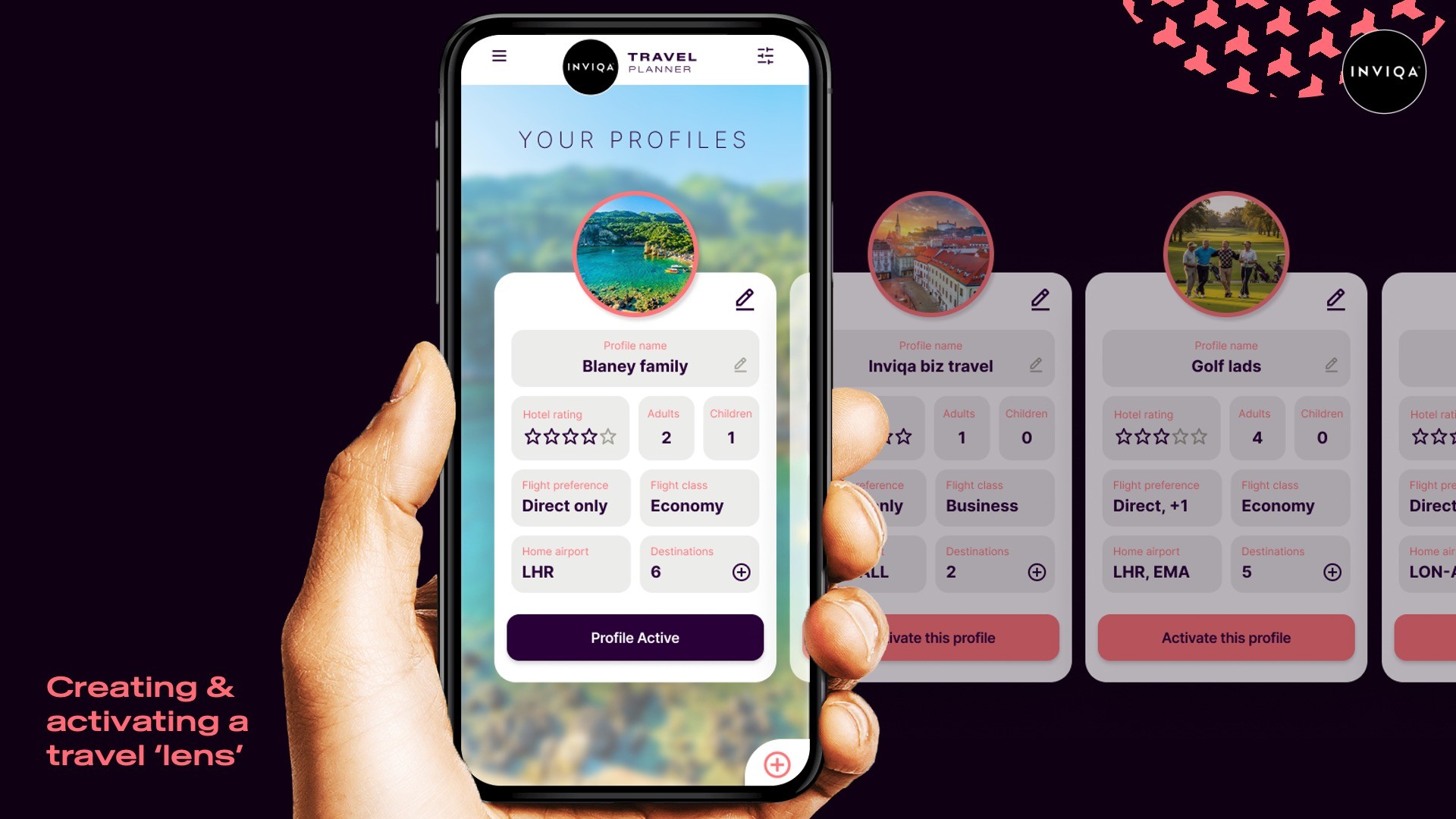
A prototype showing how different travel personas change search criteria could ease the planning process
AI can apply different lenses, remembering some preferences for one trip and ignoring them for another, helping planning feel more relevant and less overwhelming.
Key takeaway
At this stage, travellers want simplicity. They want to feel calm and confident in their choice. When planning feels calm, people commit more confidently and don’t churn emotionally post-booking.
At the booking stage
This is the big one, when emotional commitment becomes financial commitment. And as a wise woman once said, you can’t send a bad holiday back.
At this stage, travellers want reassurance, flexibility, control, and clarity about their booking choice. And rather than looking at it as a conversion event, travel brands should look at it as a transfer of trust.
Travellers will often still be assessing risk, and so the actual act of booking may not be linear.
Brands will often misinterpret this hesitation, or taking the time to pause, as resistance and respond with pressure - urgency, discounts, reminders - all with an end goal of conversion.
But these only work if certainty exists; otherwise, it’s more likely to add to any anxiety they’re already feeling.
How AI can enhance the experience
AI can learn to tell the difference between whether someone needs reassurance or whether they’re just not interested and adapt the experience to give people permission to pause if they’re not yet ready to commit.
There are brands that have already built these kinds of trust signals into the booking experience. Think booking.com with its free cancellation and pay-later options, or Skyscanner, which tells you the best time to book those flights you’ve been eyeing.
A more recently emerged example is Gondola, an accommodation aggregator & booking platform that links bookings directly to a hotel’s loyalty programme and will automatically rebook at a lower rate if the price drops. This is made possible by agentic AI that can interpret changes on a webpage rather than relying on brittle scraping rules.
Key takeaway
While this phase can feel transactional, this stage is all about the transfer of trust and respect. Conversion techniques can work, but consider who benefits – the traveller, or your brand. If the answer is “the brand”, it may be time for a rethink.
During the experience stage
It’s here, the moment you’ve agonised about. You’re about to find out if you made the right decision and whether the reality will live up to the expectations.
At this stage, travellers want to enjoy their holiday. They don’t want to be bombarded with notifications, reminders, suggestions.
How AI can enhance the experience
At this stage, AI should help preserve the flow. Rather than trying to drive interactions or compete for attention, it should allow for proactive inspiration and moments of serendipity.
The best AI during this stage is invisible, but available.
Alex showed a prototype trip itinerary, with activities and attractions scheduled in. AI then quietly identifies gaps in your day, and the user can decide whether to ask for inspiration to fill the gap or put their phone back in their pocket and aimlessly wander for a few hours instead.
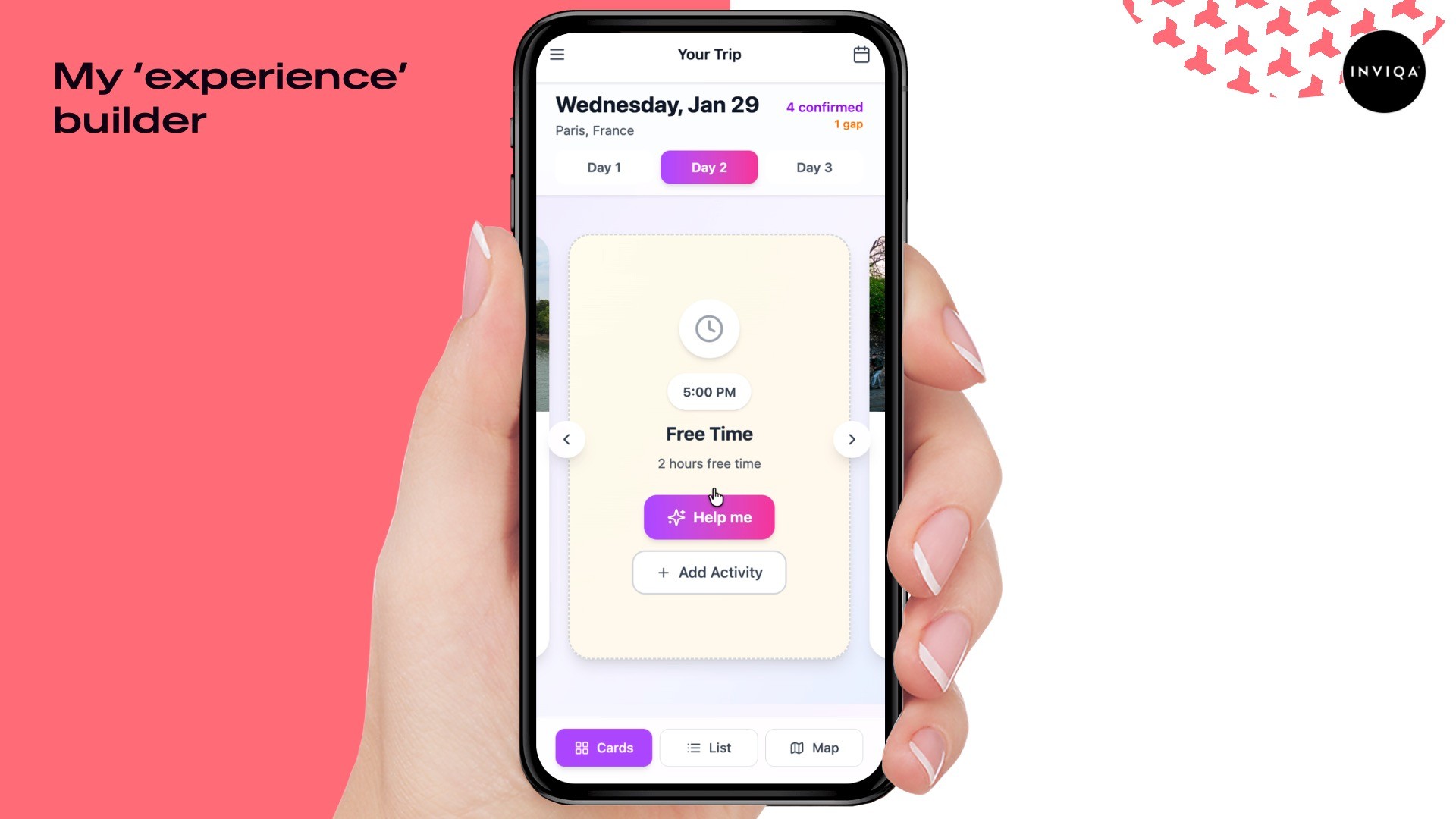
A prototype of how a travel planner could look where suggestions can be asked for by the user, rather than app-prompted
Key takeaway
This stage is about enhancement, not intrusion. When an experience feels seamless, the brand becomes associated with effortlessness, not control.
The snap back to reality stage
It’s the thing everyone dreads. The return to the everyday. The reality.
But it’s also the phase where you get to revel in your memories of your time away.
This stage should be about enhancing the memory, meaning and continuity – not retention mechanics. People don’t want surveys; they want to share their memories and relive the experience, and if they are going to engage with a brand, they want to feel remembered.
Unfortunately, most post-trip communication is a data-gathering and point-scoring exercise, which does nothing to help build a sense of self or loyalty to a brand.
How AI can enhance the experience
AI can look at behaviour, not just feedback, and detect moments of emotional significance. It can understand what mattered, not just what was highly rated, and use that to shape the next journey.
AI can also help repackage highlights from the trip – think Spotify Wrapped or Strava’s Year in Sport, but for travel. A ‘Your Year in Travel’ reel capturing where you went, what you loved, and the patterns that make you you.
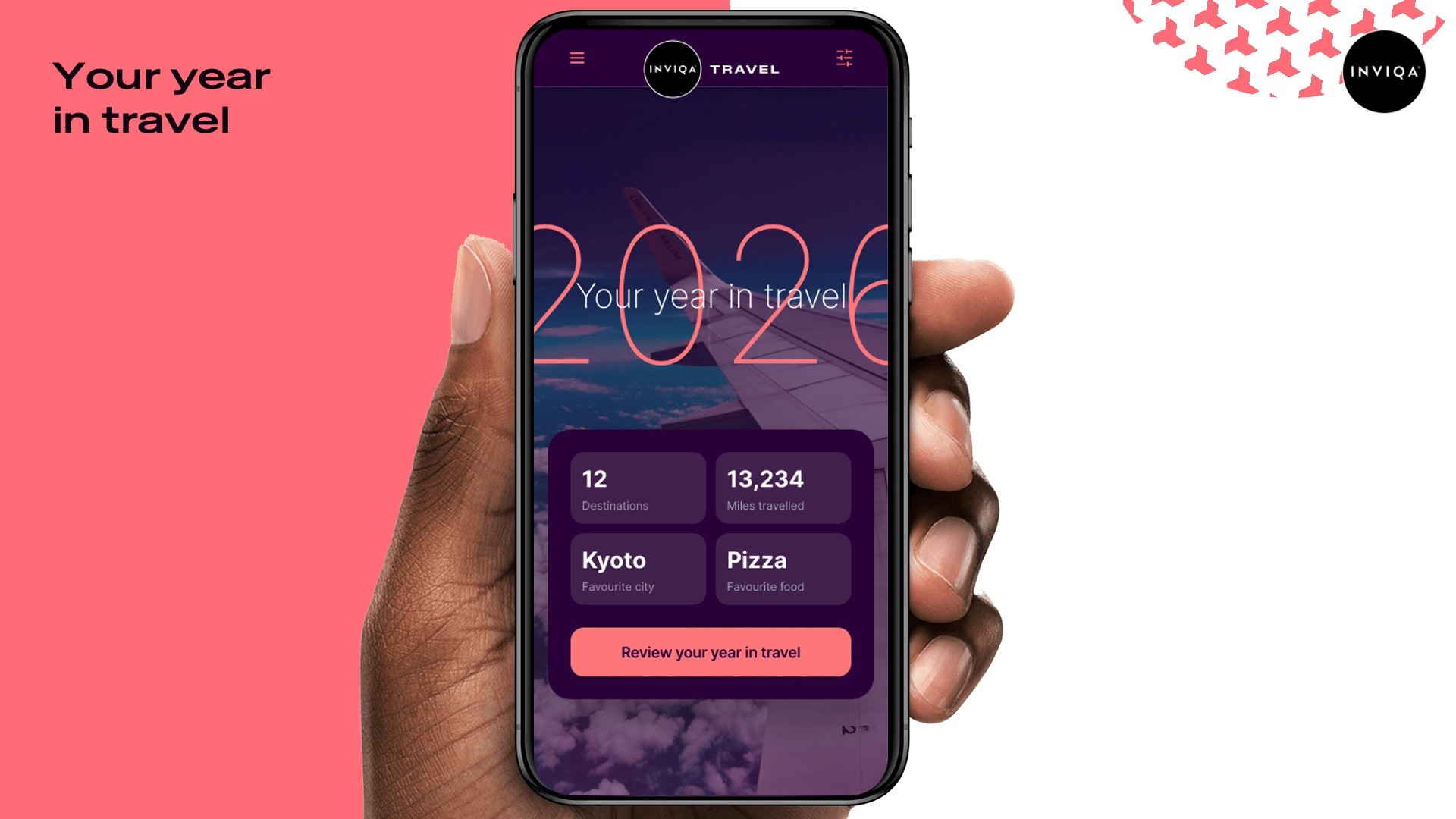
The Inviqa year in Travel app prototype
If people can recognise themselves in the data, emotional loyalty will follow.
Agentic AI isn’t going to replace the magic of travel. However, it can help make every stage of the journey feel calmer, more human and far more personal. From helping people dream without pressure, removing the anxiety from planning, making booking feel like a genuine transfer of trust, through to invisible support on the trip and meaningful memory building at the end, AI has the potential to make travel genuinely better for both travellers and brands.
If you want to dive deeper into the examples, thinking and “wouldn’t it be cool if…” moments, you can watch the full recording here.