Why the new travel trust problem isn't apathy, it's overwhelm
If you work in the travel industry, you've likely been told you have a loyalty problem. This piece, by Amelia Dolan, offers an alternative - and more actionable - diagnosis.
She explains that travellers haven’t stopped caring about travel, but they have become more cautious about where they place emotional trust. Due to rising complexity, opaque policies and fragile service recovery, responsibility has shifted from brands to customers, turning guests into operators who have to supervise their own journeys. What appears to be weakening attachment is better understood as conditional trust: care that is deliberately withheld until reassurance is earned, particularly when things don’t go to plan.
As AI reshapes how trips are planned and framed, this tension is impossible to ignore. Conversational assistants now deliver coherent, resolved narratives upstream, and customers arrive at your experience to validate decisions, not explore options. That makes friction, inconsistency and broken handoffs far more visible – and far less forgivable.
According to Amelia, the opportunity ahead is not to use AI to make people care more, but to make caring feel safe again by reducing effort, clarifying trade-offs, preserving context across touchpoints and owning exception handling end-to-end.
This is where trust will be rebuilt, she says, and where real competitive advantage will be created.
Something in travel isn’t working the way it used to. Loyalty feels more fragile. One poor experience seems to undo far more value than it once did. Customers move quickly when things go wrong, and they’re far less patient when it does.
This tension was laid out head-on at Havas’ Adapt or Disappear travel session, which brought together airlines, hotels, ferries, and platforms to discuss a familiar agenda of challenges: rising costs, changing traveller expectations, AI accelerating planning and booking, and the challenge of scaling automation without stripping travel of its human magic.
The discussion wasn’t speculative. It focused on pressure points: where friction is accumulating, who absorbs it, and why the usual growth levers feel less reliable than they once did.
One data point from the Meaningful Brand’s study cut through the conversation:
‘86% of travel brands wouldn’t really be missed if they disappeared.’
The immediate diagnosis is that this reflects declining loyalty: brands converging, people caring less, emotional connection eroding. On that reading, the prescription is predictable: more storytelling, more personalisation, more attempts to “build meaning”.
But that diagnosis doesn’t fully hold up against traveller behaviour.
If this were apathy, we’d expect to see disengagement. However, recent travel reports show sustained planning behaviour, cross-platform comparison and a continued preference for flexible terms. People are not drifting into bookings. Travellers are taking time, pressure-testing options and considering what happens if plans change.
When confidence breaks, the response is often decisive. Switching tends to follow a breakdown in trust rather than precede it, and negative experiences are shared publicly. That pattern is difficult to reconcile with indifference. It looks less like apathy and more like caution.
A more accurate description is conditional trust.
The desire for travel, anticipation, escape, meaning, hasn’t disappeared. What has changed is the willingness to offer emotional commitment upfront. Attachment is increasingly withheld until reassurance is earned; care has become selective.
Appetite remains, but the terms have changed.
More effort, less emotional credit
Planning has become heavier, not just in volume but in responsibility. Travellers aren’t only choosing where to go, they’re assessing risk.
What happens if this is cancelled? How easy is it to change? Who do I call if something breaks? They’re preparing not just for the holiday, but for the possibility that something will go wrong, because experience has taught them that, if it does, they’ll be the ones expected to deal with it.
Travel has always involved complexity. What’s changed is who absorbs it.
People are doing more work to reach the same baseline of confidence they once assumed. Policies require interpretation. Flexibility tiers require decoding. Cross-channel journeys require manual coordination.
When effort rises, and outcomes feel uncertain, emotional investment becomes provisional rather than automatic.
Seen through this lens, the 86% statistic becomes less mysterious. Interchangeability isn’t simply a failure of differentiation. It’s often a rational response to systems that require supervision.
It provokes a sharper question: At what point in the journey does the traveller stop being a guest and start becoming the operator?
The operator moment
That shift doesn’t require dramatic failure. It happens in predictable places: moments where the journey deviates from the happy path and the system asks the customer to absorb complexity it hasn’t fully resolved itself.
You see it visibly in a handful of pressure points:
- Policy opacity and rule complexity: Fare rules, cancellation terms, refund paths, baggage policies, layered “flex” tiers: these are often hard to compare and harder to trust. What’s presented as choice can feel like detective work. The issue isn’t complexity alone, but fear of the penalty of getting it wrong.
- Exception-handling, not only when journeys collapse, but when they might. Delays, cancellations, missed connections, and room issues; these moments reveal whether complexity is absorbed by the system or exported to the customer.
Too often, the default experience is: the customer resolves it. Find the right channel. Repeat their details. Join the queue. Coordinate the resolution.
- Cross-channel handoffs reinforce this dynamic. When context doesn’t travel cleanly across touchpoints, between app, web, call centre, OTA, partner, or property, the traveller becomes the courier of their own problem.
What underpins all three is imbalance: accountability is asymmetric.
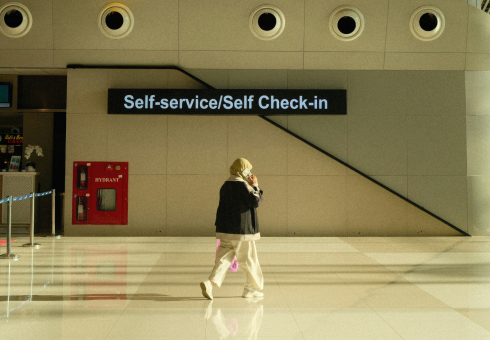
Self-check-in, self-service, and self-resolution are not neutral design decisions in this context. They formalise that transfer of responsibility. In a category built on being looked after, they make the shift visible.
When something goes wrong, the customer’s cost is immediate: time lost, money at risk, stress under pressure. The organisation’s cost is often deferred or distributed: a case logged, a backlog added to, compensation processed later.
Over time, that asymmetry trains vigilance. Travellers check, re-check, screenshot and document.
That shift, from assumed care to assumed oversight, is the operator moment: the point at which the traveller stops feeling like a guest and starts acting as its coordinator; responsible not just for choosing the journey, but for keeping it on track.
The false promise of choice
None of this emerged accidentally.
For two decades, the category has been built on a largely uncontested assumption:
More choice + more flexibility + more control = more value.
Digital widened access; it reduced gatekeepers and gave travellers agency they didn’t previously have.
Choice felt empowering because it removed friction.
But in an environment where people are already stretched, cognitively, emotionally, and financially, the same logic now produces a different outcome. It increases effort, transfers responsibility and turns planning into work.
Choice is only empowering when three conditions are met:
- the comparison burden is manageable,
- the consequences of getting it wrong are low,
- and the system will catch you when something deviates
Travel fails those conditions more often than most categories.
It’s expensive. It’s time-bound. It involves multiple parties with different incentives. And it’s operationally brittle. And importantly, it’s irreversible: you can’t send a bad holiday back. Every additional option, rule, tier, or exception expands the surface area for error.
This may help explain renewed demand for contained formats such as premium all-inclusive.
If the operator shift is what’s thinning attachment, premium all-inclusive starts to look less like indulgence and more like a deliberate reduction of variables: fewer decisions at the point of stay, fewer opportunities for misinterpretation. A clearer boundary around what the guest is and isn’t responsible for once they arrive.
The industry optimised for control and optionality and underestimated the psychological cost of supervising it.
Viewed this way, thinning attachment becomes less surprising. Emotional investment is difficult to sustain when the experience repeatedly asks the customer to manage complexity they didn’t create.
This is not a failure of intention. It is a mismatch between strategic logic and customer reality, and it's in that mismatch that hospitality begins to erode.
Interchangeability, in this context, is not simply about weak brand differentiation. It's about travellers gravitating toward systems that appear to require less supervision.
And AI?
AI changes the stakes, not just the tools
Intermediaries in travel are not new: Google, OTAs, metasearch and human agents have shaped discovery and comparison for years. People will continue to search. Many will continue to book through the channels they know. In some cases, agents are chosen precisely because someone else is expected to carry complexity and risk.
What conversational AI changes is not the route to booking so much as the texture of decision-making.
Instead of presenting options and filters, it presents a version of the trip that already feels resolved. It narrows, summarises, frames trade-offs and compresses pages of conditional detail into something coherent. A recommendation arrives as a story: this is the best option, this is what it includes, this is how the journey should unfold.
That reshapes the reference point for effort.
By the time the traveller reaches your site, app or property, the story has already taken shape elsewhere. They are no longer exploring; they are validating. They are checking whether your version of events matches the one they’ve already accepted.
For years, decoding fare rules, checking refund terms and validating inclusions were accepted as inherent to travel. Now, with answers arriving pre-packaged and framed, that same work feels heavier. The mechanics haven’t changed, but the patience for personally navigating them has.
When early stages feel synthesised and coherent, inconsistencies inside the brand environment become more visible.
If policy detail suddenly expands, inclusions need reinterpreting, and you’re manually re-entering the same information, the contrast is sharp. These moments interrupt a decision that already felt settled.
As more of the early journey is summarised upstream, travellers also arrive with less practical familiarity with how everything fits together. When something deviates, it feels less like operational complexity and more like a breach of expectation. The brand absorbs that tension.
The customer experiences one journey. The organisation delivers it through layered teams, contracts and technologies. When those seams become visible, the experience fractures.
AI does not create that structural gap. It accelerates the moment at which it becomes visible.
In a market where attachment is already cautious, that visibility carries commercial consequences. The question is not whether AI improves planning efficiency, but whether the experience behind the brand aligns with the story AI is now helping to tell.
Trust and experience, rewritten in this context
A lot of the event discussion returned to trust, explicitly in P&O’s story of rebuilding relevance, implicitly in Whitbread’s focus on consistency at scale, and in Bloomberg’s emphasis on credible voices and data-led storytelling.
If you take the behavioural and structural shifts seriously, trust needs to be defined differently.
Trust is less about stated values and more about predictability under uncertainty.
It’s “Do I trust what will happen if I choose you, especially if something goes wrong?”
Where advantage now sits
The strategic opportunity in travel right now is not to make people care more. It is to make caring feel safer again.
That means building systems that:
- reduce avoidable effort,
- make policies and trade-offs legible,
- handle exceptions with accountability,
- preserve customer context across touchpoints,
- and ensure the brand is accurately represented in the assistant-mediated layer that is now shaping discovery
Seen this way, the 86% statistic reads differently. It's not evidence that travel has lost meaning. It suggests that too many journeys ask for emotional commitment while placing too much practical responsibility on the traveller.
Nothing about travel’s desire has weakened. What has changed is the threshold at which that desire converts into attachment.
For brands, that's not a branding challenge. It's a consistency challenge.
Preference can still be created, but whether it compounds depends on operational coherence.
That is where the advantage now sits.

On demand: Unpacking Intelligent Travel
Watch the replay of our webinar, which explores what travel brands can do to meet changing traveller behaviour at each stage of the journey.